Friday, February 21, 2014

Canada Outplays USA, Wins 1-0

When the Team USA roster was announced, there were criticisms that it didn't have enough offensive firepower. Those critics, sadly, were proven right as Canada shut out Team USA 1-0. Canada will now play for the gold against Sweden on Sunday, and the US will play Finland for bronze Saturday.

The argument defending USA's roster choices was that guys like Phil Kessel and Patrick Kane would do the scoring. The team lacked offensive depth, but had powerful offense at the top. Kessel had a good Olympics. Patrick Kane failed to score a goal. Team USA needed Kane in this game and he didn't deliver.

The US got 30 shots on goal, but only a handful truly challenged Carey Price. Most possessions were one and done. Most shots hit Price right in the maple leaf.

Give lots of credit to Canada's layered defense, a testament to assistant coach Claude Julien, whose layered defense has been a staple of the Boston Bruins' success for several years.

While Canada's layered defense remained strong, Team USA allowed a goal because of defensive mistakes. Ryan Callahan got careless and didn't cover his man (Jay Bouwmeester) on the point, and didn't cover his space in that part of the ice. An open Bouwmeester threatened to shoot, which Jonathan Quick had to respect, and an opportunistic Jamie Benn slipped into the space vacated by Callahan, and tipped Bouwmeester's shot-pass into an open net.

Phil Kessel's game was a microcosm of USA's game as a whole. He had a few chances on breakaways, using his speed. But after the initial shot there wasn't enough support to maintain pressure on Price. Kessel also had a number of giveaways and passes intercepted in the neutral zone. So did Ryan Suter. So did Kevin Shattenkirk. Too many USA possessions ended before they made it through the neutral zone.

Kessel's play in this game is exactly why I'm glad he's no longer a Bruin.

While Canada's defense reminded me of the Bruins, Team USA's power play also, unfortunately, reminded me of the Bruins. There wasn't any movement away from the puck, which put the onus of creating passing lanes on the puck carrier. So the puck carrier was forced to protect the puck AND move around enough to get his 4 teammates open. That's just not good.

The ice sheet is 100 feet wide, and Team USA only used the 10 feet along the boards when they had a power play. This was exactly what Canada wanted.

Canada won the battles behind the net, in front of the net, along the boards. It's not that the US didn't have enough talent to beat Canada. The US didn't have execution. Jonathan Quick played a great game, good enough to neutralize any talent edge Canada had. The US wasted 3 power play opportunities, didn't support the puck, didn't take care of the puck in the neutral zone.

Just a bad game. And I'm disappointed in this team. Had they played great and lost, I'd be content with a bronze. They didn't play great, most didn't play good.

Go Sweden.

USA vs. Canada Preview: Epic Fucking Hockey

One of the many things I love about Olympic hockey is that on the top teams, all these guys know each other. They've played against each other for years in the NHL, sometimes in the same division, sometimes with each other on the same teams. There's familiarity, and that breeds contempt. Then add the national rivalry and the high stakes with a chance for Olympic gold on the line, and the result is epic hockey. Not good hockey, not great hockey, epic fucking hockey.

For the US to win this game, they need goaltending. Jonathan Quick has been great during these Olympics, and they need that to continue. Quick can't let in any soft goals. And he's going to have to make at least one, but probably two or more brilliant, improvisational saves for the US to win. Goaltending is Team USA's biggest edge in this game. They need to press that advantage.

I also think Patrick Kane needs to score. In 4 games he has 4 assists and is +3, which would be good for a stretch of NHL games. However, when the US is playing Slovenia and Slovakia, and scoring 19 goals in 4 games, you'd expect more from production from a guy like Kane. We've seen how he can carry a team like he did the Chicago Blackhawks in the Stanley Cup. He needs to carry some of the load for Team USA.

The US also can't take any stupid penalties. Canada will play physical, they'll try to get under Team USA's skin, they might even embellish a few hits trying to get a call. Guys like Brooks Orpik need to remember that there are rules, they will be enforced, and Canada's power play is not something you want to give bonus opportunities to.

There will be a lot of pressure on USA's defensemen. The US has a lot of young defensemen and they have to face guys like Sydney Crosby, who know how to take advantage of inexperienced defensemen. Mistakes will happen, but there's a limit. And Quick can/must cover for errors made by Team USA's blue-liners.

This game is going to be a 60 minute (or more) arm wrestling match for control. Control of the puck, control of which zone the puck is in, control of the boards, and control of the area near the nets. Team USA has easily dominated those dirty areas against their European competition but Canada will not let them do that. Team USA can win battles down there, but it won't be nearly as lopsided in USA's favor as it has been against the Europeans. Shea Weber is 6' 4" and 233 pounds and will not be dislodged with ease.

Speed will be essential on the big ice surface. But both of these teams are very good at tightening up the game so all the meaningful battles and plays are made in confined space. There will be the occasional end to end, fast-paced stretches of play, but I think most of the game-changing plays will be made in close-quartered battles. Speed helps you enter those battles with momentum and an advantage. And speed helps you take advantage of pucks won in those areas.

I can talk and talk about this game forever. I'm literally fantasizing about it right now. You've got so many great players involved. All-Stars, Stanley Cup winners, 24 guys from the 2010 gold medal game.

You have 3 MVPs (Crosby, Corey Perry, Martin St. Louis), 2 Norris Trophy winners (P.K. Subban, Duncan Keith), 3 of the last 4 Conn Smythe winners (Patrick Kane, Jonathan Quick, Jonathan Toews), and there are 4 Jack Adams coach of the year award winners behind the two benches.

This is going to be great. And the winner gets a chance to play for gold, the loser goes to the bronze medal game.

The game will be on NBC Sports, and WEEI in Boston will be broadcasting it over the radio.

Thursday, February 20, 2014

Boston College Beats Syracuse, Wins One for Dick Kelley

Boston College was tied for last in the ACC coming into this game. The only ACC team they'd beaten was the other team in the basement, Virginia Tech. BC had losses against Providence, Toledo, VCU, Harvard. They barely beat Florida Atlantic and needed overtime to beat Sacred Heart. They'd lost 5 straight, were 1-8 in their last 9, and 2-12 in their last 14.

A few days ago I actually thought that BC might have a chance in this game. But I dismissed the idea very quickly because BC has struggled to finish games all season long. So even if they kept up with Syracuse, they wouldn't make the necessary plays at the end of the game. My initial reasoning behind the dismissed notion was based on BC playing Syracuse relatively close in January, losing 69-59. And Syracuse looking ahead to a big game against Duke this weekend. Also, Syracuse has barely won their last few games.

BC did what they had to do in order to win. They hit 3-pointers (11 of 22), and they didn't turn the ball over after halftime (12 turnovers in the first half, only 5 in the second and OT). Syracuse helped BC out. The Orange shot an abysmal 20 for 62 (32.3%) from the field, only hit 2 of 12 3-pointers, and were 17 of 24 with their free throws. Down the stretch missed free throws killed the Cuse.

Patrick Heckmann, a junior guard from Mainz, Germany, carried BC in overtime. If you look at the box score his overall contribution seems minimal. In 25 minutes off the bench he scored 9 points with 4 rebounds. He had a block, a steal, and committed 3 fouls.

In the overtime, Heckmann scored 5 of his 9 points, including a layup with 0:46 left that gave BC a 58-57 lead. Heckmann also had a block and a rebound.

This was a vital contribution because players like Ryan Anderson were falling all over themselves trying (and failing) to make big plays in the big moment.

The other OT hero was Lonnie Jackson. Syracuse fouled him twice with under a minute left because he's a 56% free throw shooter. It was still a 1-and-1 situation, so any missed free throws could have been game-deciding. Jackson hit all 4 free throws. Many players see their FT% go down in pressure situations, Jackson's went up. Way up.

BC scored 12 points in overtime. 5 were from Heckmann, 4 from Jackson. Jackson also had an assist on an Olivier Hanlan three pointer in OT.

I enjoyed this win for two reasons. I hate Syracuse. I'm friends with a number of their fans from my time living in Central New York, and when they put their orange goggles on, it's always annoying. SU fans struggle to see reality when it comes to their beloved Orange. They're impossible to converse rationally with.

The main reason I enjoyed this win, however, was because of the passing of Dick Kelley. You've probably heard broadcasters speaking of him during college games this past week. If not, I'll just tell you that Dick Kelley was the assistant athletic director for media relations at BC, which made him a focal point within BC's athletic program, a hub of communications for a wide variety of people and groups. He'd interact with athletes, coaches, other departments in athletics and in the school, just about everybody. Before games you'd see him patrolling media row, having countless conversations with anybody and everybody, and then he'd ask a BC player to pass him a ball during warm-ups and they'd talk for a bit. He died at the age of 48 last Thursday after a 3 year battle with ALS. And it was one hell of a battle.

Dick Kelley was a man who cared deeply about his work, and about what his work could do for other people, from the media to student athletes. He treated everyone with remarkable kindness and a warm smile, which makes sense since he had a remarkably kind family. He was, and forever will be, a big part of the BC family.

This win was for Dick Kelley.


Photo Credit:
USATSI

Wednesday, February 19, 2014

Tuukka Rask Finnishes Off Russia

Apart from Pavel Datsyuk, and Evgeni Malkin kind of, Russian hockey players typically fail to do the little things. Alex Ovechkin, for instance. He's a great scorer, he's strong on the puck, yet he doesn't do the small things that you see star players on other teams do. And that's a theme in Russian hockey. It's also the reason why they lost 3-1 to Finland.

Russia also struggles to build on plays as a team. This is an extension of the lack-of-little-things issue. The Russians don't string together small plays and turn them into big opportunities.

What Russia lacks as a team, Finland has in abundance. They attack as a team, they defend as a team, they line up in the neutral zone as a team. Everyone's on the same page.

This game was a series of Russian mistakes. Their first mistake was to continue with their strange goalie rotation and keep Vezina winner Sergei Bobrovsky on the bench. Semyon Varlamov got the start and allowed 2 soft goals. He was eventually pulled. Bobrovsky looked good in his two games before this. Why bench him in the most important game against a tough opponent?

Ilya Kovalchuk gave Russia a 1-0 lead with a power play goal. His celebration was so exuberant, it was almost too much. He jumped up as if he had scored an overtime game winner. I know emotions were riding high, but it was the first period. Russia played this entire tournament unable to control their emotions.

Finland scored their first goal after Russia needlessly iced the puck in an attempt to make a big play. Juhamatti Aaltonen weaved through Russians who stood around like cones. Then Varlamov failed to make a routine save.

A bad bounce on chipped ice resulted in a Teemu Selanne breakaway goal. So that means the Russians were betrayed by their own flimsy post against Team USA and now by their imperfect ice surface. Russia, you're supposed to have an advantage at home. Your own building shouldn't be sabotaging you.

Penalty killing requires players who do little things and who work as a team. Since those are two things Russia struggles with, it's not surprising that they allowed a power play goal. The penalty itself was unforced and unnecessary.

Tuukka Rask played a great game. He stopped 37 of 38 shots. The one goal he did allow was slightly soft, but he more than made up for it by making two or three incredible stops. That's usually the story with Rask. He will let in the occasional bad goal. His big saves usually outnumber those soft goals.

Russia is out of their own Olympics. That pleases me greatly.

Finland plays Sweden in the semifinals Friday morning at 6:30am (Eastern) on NBC Sports. So we have a European semifinal and a North American semifinal.

Photo Credit:
Alexander Nemenov /AFP/Getty Images

Olympic Hockey: Swedes Speed Past Slovenia

The Swedish play a methodical, confident style of hockey. They don't panic, they don't rush, they don't force plays that aren't there. They possess the puck, make their opponent skate around, then they use their high skill level and speed to make things happen. That's what they did to Slovenia, winning 5-0 to advance to the semifinals.

Even though the Swedes were an overwhelming favorite against Slovenia, this was a 0-0 game for almost the entire first period. It was a 1-0 game until early in the 3rd. The Swedes didn't score much for 40 minutes, but they were dictating the entire 60 minutes of this game. Slovenia had a handful of chances, but Henrik Lundqvist stopped them all. Lundqvist is another reason the Swedes can play with such patience and composure.

Alex Steen scored a power play goal in the 1st to put Sweden up 1-0. Then in the 3rd the Swedes broke the game open as the Slovenians looked exhausted. Loui Eriksson of the Boston Bruins set up Daniel Sedin to make it 2-0. Then Eriksson scored himself. Carl Hagelin scored the last two goals to make it 5-0. Erik Karlsson had an assist on Sweden's first goal and their last goal.

Henrik Lundqvist stopped 19 shots and recorded his second shutout of the Olympics. He's allowed 5 goals in 4 games and of the goalies on the four teams still standing, he's played the best at Sochi.

The Swedes will play Finland Friday morning at 6:30 (Eastern) on NBC Sports. This is a rematch of the 2006 gold medal game in Torino. Sweden won that game 3-2, and I think you'll see a similar result Friday.

Photo Credit:
AP Photo/Julio Cortez

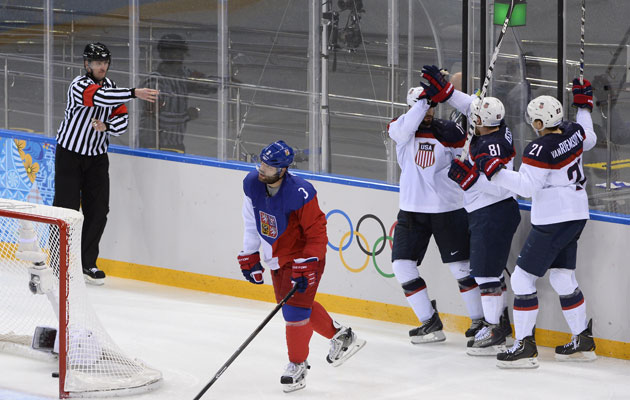
Team USA Wrecks the Czechs, Advances to Olympic Semifinals

This was such an excellent, complete win. Just about everybody who took the ice for Team USA made a significant contribution. The coaching staff also came up with a good gameplan to neutralize the Czech Republic's strengths.

Five different USA players scored goals: James van Riemsdyk, Dustin Brown, David Backes, Zach Parise, and Phil Kessel. Ryan Suter had 3 assists, Ryan Kesler had 2. The US scored 4 of their goals in the dirty area of the ice close to the net. The 5th goal was on a breakaway that utilized the vast width of the European ice sheet.

The US won essentially all of the physical battles. This was spearheaded by guys like Ryan Callahan and David Backes. Brooks Orpik also did some hitting, and some of those hits were legal.

Defensively USA didn't allow the best Czech players the time and space to make plays. Jaromir Jagr only got one shot on goal, as did David Krejci. In the first two periods the Czechs only got 13 shots on Jonathan Quick. And one of those was actually a botched Ryan McDonagh clearance attempt that ricocheted off of Ryan Suter's skate and into the US net.

The only Czechs who were consistent threats were Ales Hemsky and Martin Hanzal (who's so hot right now).


Jonathan Quick didn't have a hard day of work in the office, but he did his job, and didn't make his teammates work harder than necessary. No soft goals.

It's impossible not to be excited by this team. They have a good mix of players who are adept at playing different kinds of hockey. They have a great goalie, strong defense, they block shots, they make hits, they're fast. There's no apparent weakness to exploit, no chinks in the armor.

That being said, their next game is their biggest test. They'll be playing Canada Friday at noon (Eastern) on NBC Sports in a rematch of the 2010 gold medal game. The winner advances to this year's gold medal game, the loser will play for bronze.

Both semifinal games are rematches of the last two gold medal games. Sweden plays Finland Friday morning at 6:30 in a rematch of 2006.

I can't wait. The US women's team will also be playing Canada for gold Thursday afternoon at noon on NBC.

Photo Credit:
Getty Images

USA 4, Czech Republic 1 After Two Periods

Team USA didn't take their foot off the gas in the 2nd period. They stepped up their physical game, which not only shut down the Czech's offense before it got started (only 6 shots on goal for them), it also gave the US momentum that eventually resulted in a goal.

For the first 9 minutes of the period, US players took advantage of every opportunity to hit the Czechs. Ryan Callahan was playing especially physically, as this tweet described very well...


The US got a power play shortly after Callahan's rampage, and you just got the feeling after all those physical wins, they'd find a way to score. And that's what happened. Zach Parise scored a goal that was both finesse and toughness. The finesse was the coordination and hands required to score, the toughness was that he scored from close range, in one of the so-called "dirty areas" of the ice.

All 4 US goals have been scored in those tight areas near the net, and the US has dominated that part of the ice in both periods so far.

So Team USA is 20 minutes away from qualifying for the semifinals and playing the winner of Latvia/Canada (which is tied 1-1 as I'm writing this).

However, you can't run out the clock in hockey. There's no such thing as a prevent defense in this game. The US needs to continue to do what they did in the first two periods: Make the Czechs work for everything. Make them pay a price for every pass. Be aggressive but be smart. Don't give them any power play chances (like Brooks Orpik did with his late hit on Jaromir Jagr. Good God I hate Orpik).

Be patient. The opportunities to hit and the opportunities to score will come.

USA Up 3-1 After 1st Period

The Czechs are not showing many signs of fatigue, despite playing back-to-back games. Perhaps they'll tire by the 3rd period, particularly older players like Jaromir Jagr.

Speaking of Jagr, he was the focus of Team USA's matchups. The Americans wanted Ryan Suter and Ryan McDonagh on the ice as the same time as him, along with the David Backes line. This matchup paid off 14:38 into the period when Backes checked Jagr and gained possession of the puck just past the Czech blue-line. A few passes later, drawing the attention of the Czech defenders to one side of the ice, and Backes found Dustin Brown on the opposite wing. Brown scored to give the US a 2-1 lead.

And with only 8 seconds left in the period, this line scored again. Ryan Suter's shot was deflected and went wide. David Backes collected the rebound off the lively boards and jammed the puck through goalie Ondrej Pavelec.

Most of the first period was played evenly between the two teams. James van Riemsdyk scored from the goal-line to put the US up 1-0. Then Alex Hemsky was credited with a goal after a puck deflected off Suter's skate and past a sprawling Jonathan Quick. The attacking play of Hemsky, David Krejci, and Milan Michalek forced the own goal.

Up 3-1, the US couldn't be in a better position. They're up 2 goals, they found a favorable matchup, the Czechs never beat Quick, and now the Czechs have to play from behind the day after playing a close game against Slovakia.

However, the US can't ease up off the gas and play a conservative game like the Finns do when they get a lead. That's not the US's style. The Americans need to continue to attack, keep the Czechs skating after them, and keep winning battles along the boards.