Showing posts with label College Basketball. Show all posts

Thursday, March 20, 2014

BC Basketball Needed a Change in Direction

A week ago, Boston College's basketball season ended when they lost 73-70 in overtime TO Georgia Tech in the ACC Tournament. This week, head coach Steve Donahue's tenure at BC also ended. It was a much needed change, for both the team and for Donahue.

BC lost 24 games this season. 9 of those were by 4 points or fewer. The Eagles were 3-9 in those close games (one of those victories was over Florida Atlantic). They had the ability to keep up with good teams, even beat Syracuse on the road, but when games were determined in the last 2-4 minutes their performance level typically dropped. They didn't rise to the occasion, they did the opposite.

As a team they were too tightly strung. They played too much with their brains and not their bodies. They lacked aggression, thinking too much instead of acting. Basketball is a game of decisiveness, and they played with indecision.

In the recruiting department they resembled an Ivy League team more than ACC team. They had quality players like Olivier Hanlan, and a handful of decent role players, but no strong athletes who could carry a team either defensively or offensively. And guys like Hanlan played soft and weak, especially when games were on the line.

And before BC people use the old "Academic Standards" refrain, those standards might make it tough to win 24 games, they don't make it so you lose 24.

Steve Donahue is a good coach. He's just not the right coach. In hindsight, BC took a guy from a small pond (Cornell and the Ivy League) and transplanted him to a shark infested ocean. Donahue got his Cornell Big Red to the Sweet 16, which is impressive, but winning two NCAA games pales in comparison to playing 18 ACC games a season.

Donahue's Eagles could win big games every once and awhile, but struggled with consistency. They could be great for 40 minutes, but failed to be good for 400 minutes. This year they were 240th in the country in points per game, 269th in points allowed, 326th in rebounds, 154th in shooting percentage.

Hopefully Donahue finds a job that fits better. Let's also not forget that he inherited a BC team that was struggling. So he was tasked with turning a team around in one of the toughest leagues in the country.

Harvard's Tommy Amaker is reportedly the leading candidate for the opening at BC. I like Amaker, but I'm not sure it's smart to once again hire an Ivy League success story. Amaker has turned Harvard into a relative powerhouse in one of the worst leagues in the country. Big fish, small pond.

Then again, he's coached in power conferences before, in both the Big East (Seton Hall) and Big Ten (Michigan). He also played in the ACC at Duke.

Then again, he never brought Michigan to the NCAA tournament and was criticized for teams that underperformed in pressure situations. That kind of sounds like what BC's been experiencing under Donahue.

THEN AGAIN, Amaker helped rebuild a Michigan program that was recovering from a scandal. Under Amaker, Michigan had significant success in the NIT. As a program, BC is in recovery mode. They shouldn't be looking for someone who can bring them to the promised land, they need someone who will turn the program around and get things going in the right direction.

But if you're Amaker, do you want to coach at BC? If you do well and bring the program back to NCAA contention, but can't get any further than the opening rounds, they'll replace you. If you don't turn things around, they'll replace you.

It is a challenge. And Amaker seems to thrive on challenges. I'm writing this 10 minutes before his Harvard Crimson tip-off in the NCAA Tournament. If they do well, he might have better job offers than BC.

Thursday, February 20, 2014

Boston College Beats Syracuse, Wins One for Dick Kelley

Boston College was tied for last in the ACC coming into this game. The only ACC team they'd beaten was the other team in the basement, Virginia Tech. BC had losses against Providence, Toledo, VCU, Harvard. They barely beat Florida Atlantic and needed overtime to beat Sacred Heart. They'd lost 5 straight, were 1-8 in their last 9, and 2-12 in their last 14.

A few days ago I actually thought that BC might have a chance in this game. But I dismissed the idea very quickly because BC has struggled to finish games all season long. So even if they kept up with Syracuse, they wouldn't make the necessary plays at the end of the game. My initial reasoning behind the dismissed notion was based on BC playing Syracuse relatively close in January, losing 69-59. And Syracuse looking ahead to a big game against Duke this weekend. Also, Syracuse has barely won their last few games.

BC did what they had to do in order to win. They hit 3-pointers (11 of 22), and they didn't turn the ball over after halftime (12 turnovers in the first half, only 5 in the second and OT). Syracuse helped BC out. The Orange shot an abysmal 20 for 62 (32.3%) from the field, only hit 2 of 12 3-pointers, and were 17 of 24 with their free throws. Down the stretch missed free throws killed the Cuse.

Patrick Heckmann, a junior guard from Mainz, Germany, carried BC in overtime. If you look at the box score his overall contribution seems minimal. In 25 minutes off the bench he scored 9 points with 4 rebounds. He had a block, a steal, and committed 3 fouls.

In the overtime, Heckmann scored 5 of his 9 points, including a layup with 0:46 left that gave BC a 58-57 lead. Heckmann also had a block and a rebound.

This was a vital contribution because players like Ryan Anderson were falling all over themselves trying (and failing) to make big plays in the big moment.

The other OT hero was Lonnie Jackson. Syracuse fouled him twice with under a minute left because he's a 56% free throw shooter. It was still a 1-and-1 situation, so any missed free throws could have been game-deciding. Jackson hit all 4 free throws. Many players see their FT% go down in pressure situations, Jackson's went up. Way up.

BC scored 12 points in overtime. 5 were from Heckmann, 4 from Jackson. Jackson also had an assist on an Olivier Hanlan three pointer in OT.

I enjoyed this win for two reasons. I hate Syracuse. I'm friends with a number of their fans from my time living in Central New York, and when they put their orange goggles on, it's always annoying. SU fans struggle to see reality when it comes to their beloved Orange. They're impossible to converse rationally with.

The main reason I enjoyed this win, however, was because of the passing of Dick Kelley. You've probably heard broadcasters speaking of him during college games this past week. If not, I'll just tell you that Dick Kelley was the assistant athletic director for media relations at BC, which made him a focal point within BC's athletic program, a hub of communications for a wide variety of people and groups. He'd interact with athletes, coaches, other departments in athletics and in the school, just about everybody. Before games you'd see him patrolling media row, having countless conversations with anybody and everybody, and then he'd ask a BC player to pass him a ball during warm-ups and they'd talk for a bit. He died at the age of 48 last Thursday after a 3 year battle with ALS. And it was one hell of a battle.

Dick Kelley was a man who cared deeply about his work, and about what his work could do for other people, from the media to student athletes. He treated everyone with remarkable kindness and a warm smile, which makes sense since he had a remarkably kind family. He was, and forever will be, a big part of the BC family.

This win was for Dick Kelley.


Photo Credit:
USATSI

Monday, February 10, 2014

Jabari Parker Makes You Say "Wow"

Duke was in town to play Boston College Saturday night, and the Blue Devils brought potential top-5 pick Jabari Parker with them. Parker drew a small army of scouts to Conte Forum, along with Boston Celtics GM Danny Ainge. They did not leave disappointed

He led Duke to an 89-68 shellacking of BC with 29 points and 16 rebounds. Five of his rebounds were on the offensive glass. He had as many total rebounds as BC had defensive rebounds.

What got my attention was how often he made me say "Wow." As if every time he made a play I was surprised. Even as he made similar plays over and over. Every time he did I was just as amazed. This was because he seemed to make these plays so effortlessly.

I'm not saying he wasn't trying. I'm saying he made the game look easy.

He played with smoothness and ease. He didn't have to push his body to make plays, it was as if he was following his body. He wasn't tense. He just flowed. His jumps looked easy, his shots, his drives, his rebounds, his dunks. I'd say he looked almost graceful, until he slammed the ball through the rim or brushed off an opponent.

He played like he was born to do nothing else. He dominated casually, like it was second nature for him to be great.

It's important to note that he was playing against a bad basketball team. A bad team that's also lacking in size. BC is 6-17 and 2-8 in the ACC.

It's also important to note that I have no experience or expertise evaluating college basketball talent then predicting how it will translate to the NBA.

However I do know special athletes when I see them. They make their game look easy. They don't look fast until they run, don't look strong until they use their muscles. And when you see what they're capable of, all you can do is say "Wow." Because even if you've seen it 100 times before, it still amazes you. Like Calvin Johnson or Rob Gronkowski. Like Martin Brodeur or Patrick Roy in their primes. Like Vladimir Guerrero years ago. You're stunned by something you've seen them do before.

That's what Jabari Parker did. He surprised me every time he did something he'd already done before.

Photo Credit:
AP Photo/Stephan Savoia

Wednesday, February 05, 2014

I Hate SportsCenter a.k.a. DunkCenter This Time of Year

I get it. NBA and NCAA basketball is significantly more popular nationwide than the NHL. And ESPN broadcasts pro and college hoops. So I'm not expecting hockey to get top billing, or second billing or third billing on SportsCenter. It would be nice to see hockey get some billing. It is, after all, a sport. And ESPN calls their flagship show SportsCenter. Sadly I don't expect SportsCenter to cover the NHL. Nevertheless I'm still disappointed that they essentially don't. And angry.

Before I rant on, no I didn't get any sleep last night, so I'm extra irritable and paranoid. And no I don't have anything better to do today than wait for snow to fall so I can clear it out of my driveway. So I watched SportsCenter and took notes.

On Tuesday night there were 9 NHL games. SportsCenter Wednesday morning showed highlights from 2 of them. There were 4 NBA games, SportsCenter showed highlights from all 4. There were 7 NCAA basketball games involving Top 25 teams, SportsCenter showed clips from 6. That's 10 basketball highlights compared to 2 hockey. And 9 of those basketball highlights came before any NHL coverage.

And what pisses me off is how repetitive and uninteresting basketball highlights are. Why are they in such relatively high demand? It baffles me. It's 80% dunks. And most of those dunks are uncontested. Dunks on the break. SportsCenter even flashed back to a high school dunking contest before showing highlights of a college game. Just to show that a certain player could dunk in high school, and his dunking continued as a Florida Gator, and with only marginally more defensive obstacles in his way.

That's what you hoop heads want to see? Tall men with long arms dropping a ball into an unguarded hole? That not only passes for entertainment, you'd rather see 10 sets of dunk heavy basketball highlights with only 2 hockey highlights? I feel kind of bad for you if you're mesmerized so easily.

There were 18 minutes of basketball highlights compared to 3 minutes of hockey highlights.

There were highlights of Duke beating Wake Forest by 20. What a nail-biter.

There was a story about the ranking of college players for the NBA Draft. That's right around the corner, isn't it? Only a few days away on June 26th.

Hockey wasn't even mentioned until Jeremy Schaap's piece on potential terrorism at the Winter Olympics, 30 minutes into the broadcast. Because who else would turn to for analysis of geopolitical friction and global terrorism?

Then there were 2 NHL games highlighted. The Rangers playing the Avalanche, and the Senators playing the Blues.

No mention of Roberto Luongo playing his first game in Boston since the 2011 Cup Finals. That wasn't nearly as important as UConn's women's basketball team crushing SMU. That brief highlight also came before hockey.

Then we get to the Top Plays, a reel of dunk highlights featuring the best dunks you've already seen in the show. Because dunks are so amazing, unique, unexpected, difficult, fun, funny, exciting, exhilarating, and most of all special. Slam dunks are special.

Eight of the Top Plays were from basketball games. One was from hockey, one from soccer. Five of the basketball plays were dunks. Most of those were uncontested, players driving through an open lane or on a break.

So of all the plays in 9 NHL games Tuesday night, only one (a save by Capitals goalie Michael Neuvirth) was on the same level as uncontested dunkage. Really? All the goals, the saves, the hits, only one of them was on par with tall men who cannot be touched on their way to the net, jumping in the air with a ball, and putting it in a hole.

That's evidently what you want, America. You can have it. Just like you can have crappy musicians that sing off key, politicians who lie to your face as you vote for them, you can watch all the amazing dunks you want.

Saturday, March 30, 2013

Wait, I Picked 7 of the Elite 8 in my Bracket?

Back in college my nickname was Robbie Mush, because every bet I made turned to mush. It was a reference to a minor character in A Bronx Tale, Eddie Mush, who at the track was given his bet-tickets already ripped up.


That's why last night I was absolutely stunned to see that I had picked 7 of the 8 teams that made the Elite Eight. The only exception being Wichita State. My brackets started off as red as anyone's but somehow I guessed the teams that would advance to this stage. Here's my bracket:


I used almost no logic to pick these teams. I don't follow NCAA hoops until the start of March, and I know little about the game, its teams, or its players. I used a few basic guidelines to fill this bracket out in less than a minute:

1. Despite early upsets, the Final Four and Elite Eight are dominated by teams seeded 1-4.

2. The 1 seeds are 1 by default, not because they are clearly superior to other teams.

3. I hate Syracuse. Which means they'll probably advance far.

4. Duke doesn't mess around when they have something to play for.

Somehow a combination of these guidelines along with the dumbest of luck has produced a bracket in the 99th percentile on Yahoo.

My Final Four are Duke, Ohio State, Michigan, and Syracuse. I have Duke defeating Michigan 65-55 in the Championship.

And I don't even care. I am much more interested in the NCAA Hockey tournament.

Monday, March 11, 2013

I Hate the Phrase "Punched Their Ticket"

This is the time of year when I become obsessed with basketball. The other 11 months I don't really care about the sport. At least not as much as football, hockey, baseball, soccer, curling, et cetera. But in March I can't get enough of the game. The mid-majors, the upsets, the buzzer beaters. The MVC, the OVC, the WCC, the ACC, the Atlantic 10, the Big Ten, the Big XII, the Big East. It's a relentless barrage of tension and thrills.

However, there is one thing about this time of year that threatens to give me a rage-induced conniption...

The phrase "punched their ticket," and all associated forms.

It's such a tired, worn-out, overused, out-of-date, unoriginal, uninteresting sports cliche. You hear it and read it constantly, in highlight reels and game recaps. "Florida Gulf Coast was the first team to punch their ticket," "Belmont punched their ticket for the third straight year," "Harvard punched their ticket because there's no tournament in the Ivy League," "Liberty punched their ticket despite 20 losses." Every conference tournament is another ticket punched. So many tickets. So many punches. So many times this same phrase is used.

The problem is, there's no other quick and colorful way to say "earned a berth in the NCAA tournament."

We must come up with another phrase. This level of repetition is unacceptable for a writer. Not to mention how out-of-date the phrase is. How often do you have a ticket that's punched these days? Here are some suggested replacements:

"Won a berth" is the most basic substitute. Although there's no flare to that. And in Sportswriting 101, future sports media are instructed to use as many formulaic, hackneyed expressions as possible, in an effort to make their writing appear interesting (see: "three-point land")

"Penetrated the bubble." I'm not sure this makes much sense, as most teams that win conference tourneys aren't bubble teams. But it sounds good. And kind of dirty.

"Date with 68." I like this, even though teams would technically have a date with 67 teams. It rhymes, it's catchy, and you can still use it when the Tournament expands to 128 teams.

"Cashed in." There's lots of money to be made by an NCAA appearance. And for USC's basketball program, this phrase is especially appropriate.

"Stamped their name on the bracket." Kind of long, but it's clear, active, and more up-to-date.

"Earned a slash." This can be used for teams that will be forced to go through one of the play-in games. Liberty, with their 20 losses, definitely earned a slash.

These are the humble suggestions of one sports fan who likes to write, and who hates hearing the same stupid phrases over and over again. I'm sure the truly great sportswriters out there, if there are any, can come up with something better. If only they tried to do so.

Wednesday, December 05, 2012

Harvard Wins Basketball Beanpot

Ten years ago, if you'd proposed a Beanpot style tournament for the college basketball teams in Boston, the idea would be dismissed because BC would be the undoubted favorite. How things have changed.

Harvard beat BC 79-63 last night. It was the Crimson's 5th straight victory over the Eagles.

What's really unfortunate for BC is that Harvard wasn't supposed to be that good this year. Harvard lost co-captains Kyle Casey and Brandyn Curry before the season due to a cheating scandal. The Crimson were 3-3 coming into this game. One of their wins was over MIT (the Engineers compete in Division III). Another win was against the Manhattan College Jaspers.

BC was actually favored to win last night's game, and it was close at halftime, with Harvard clinging to a 31-29 lead. Then the Crimson started the 2nd half with a 7-0 run and kept their foot on the gas. BC simply could not stop them. Harvard went on an 11-0 run after the first media timeout. The game was effectively over with 12 minutes left to play.

Sivani Chambers scored 21 points for Harvard. Wesley Saunders added 18. Jonah Travis scored 14. For BC, Ryan Anderson stood out, scoring 23 very hard points, mostly down low. No other Eagle scored more than 15, and only two others scored more than 10.

Harvard won the physical battles. They got some key offensive rebounds and had 9 team steals compared to BC's 2. They also got to the line more often, and shot better with their 3-pointers.

Ten years ago BC was a perennial NCAA tournament team, the undisputed best college basketball team in Boston, and behind UConn the second best team in New England. Now, there's no other way to put it, BC is Harvard's bitch.

Photo Credit:
Boston Globe

Thursday, March 15, 2012

Obama's Final Four

President Barack Obama unveiled his NCAA Final Four picks: Kentucky, Ohio State, Missouri, and North Carolina. He selected UNC to win the Championship.

Obviously Kentucky is a standard pick to go deep. #1 team in the country, #1 overall seed. They do have Duke in their bracket. But the President is politically savvy enough to know that most people hate Duke. Obama did pick the Blue Devils last year. Then again, he didn't have to run for President last year. More voters hate Duke than like Duke.

Obama might have picked Ohio State because of Fab Melo's ineligibility hurting Syracuse. Or because Ohio has 20 electoral votes and is perhaps the most important swing state in the election. No Republican has ever been elected President without winning Ohio. In other words, Obama winning Ohio blocks the Republican road to the White House

The Missouri pick reflects one of the "sexy" picks to win the tournament. Mizzou's won 30 games and have a good shot to beat Michigan State in their region. Obama lost Missouri by 0.14% in November of 2008. 3,903 votes. The Mizzou Arena holds 15,061 fans. If Obama gets some Tiger fans to switch sides, he could win Missouri in 2012.

North Carolina is a good basketball pick. Obama probably wants to avoid Kansas, too, as he's picked the Jayhawks before and they've been disappointing in tournament play. This is also a good political pick. Obama won North Carolina in 2008, by 0.32%. His margin of victory was 14,177 votes in the usually Republican state. North Carolina will probably return to the GOP column in 2012, but with Obama picking the Tar Heels to win it all, perhaps the Republicans won't be able to cover the spread.

Thursday, March 08, 2012

ESPN: Entertainment and Syracuse Protecting Network

ESPN has a voracious appetite for big stories. But they're allergic when Syracuse basketball is on the menu. Cuse runs a dirty program. The #2 team in the country has been failing to punish (or even notify) players that have tested positive for illegal drugs. The timeline of the infractions includes SU’s 2003 NCAA title run. Seems like an interesting story. I wonder why ESPN barely covered it.

Marv Albert. Bob Costas. Sean McDonough. Jayson Stark. Mike Tirico. Syracuse University produces sports media personalities like the 1980's Miami Hurricanes produced quarterbacks. Actually, it's like Miami with QBs, Auburn with RBs, Penn State with LBs, and USC with WRs all combined. That's how abundant Syracuse grads are in sports media. If you want to get to Bristol, CT, the road starts in Syracuse, NY.

I went to college 56 miles south of Syracuse. That entire region of New York state revolves around SU basketball. In Central NY, Jim Boeheim is Lord of the Realm and Syracuse BBall is more like a religion than a sports team. And why not? There’s nothing else there to divert attention and affection from SU BBall. The AAA Syracuse Sky Chiefs are the next biggest team in the area.

Syracuse's biggest fans might be the future sportscasters, reporters, editors, directors, and writers that matriculate at SU's Newhouse School of Public Communications. It makes sense. Young men and women who passionately love sports (so much so that they want a career watching and discussing sporting events), congregate in the middle of New York and the one team (and only team) they can all root for is Syracuse basketball.

It's the only story to cover, the only game to talk about, the only team to love. Even when struggling, SU BBall set attendance records for NIT games. Their fanbase is rabidly devoted to that team.


These intensely dedicated student fans don't leave their passion behind when they graduate, take off their orange t-shirts, put on a suit and tie, grab a microphone, and cover sports for ESPN. There may be no cheering in the press box, but if cut, these people will bleed orange.

Normally, the prospect of a big news story makes a reporter salivate like a dog in a butcher‘s shop. Reporters relentlessly dig for information, writers type stories all night, producers and executives dedicate hours of TV time to coverage. Perfect example: Penn State sexual abuse scandal. That story was covered so heavily and closely that the story about the story became a massive story in and of itself.

But when Syracuse assistant Bernie Fine was accused of something similar, there were no banner headlines. There were no live broadcasts from Onondoga County. It was a side story, almost a footnote to the Penn State scandal.

When Boeheim accused the accusers of lying and seeking only money, the outcry was minimal. Boeheim's insensitive remarks weren't plastered across ESPN.com. They were buried. To Boeheim's credit, he did apologize.

ESPN used their shovels to unearth and excavate the Penn State sex scandal. They then used the same shovels to bury the Syracuse sex scandal. ESPN originally buried the story in 2002 when it failed to disclose the accusations, despite having this audio tape in its possession:


One of Bernie Fine's accusers gave this audio tape to ESPN. ESPN reported nothing. Did they investigate the story? Probably. Did they investigate with the same relentless drive that they investigated Sandusky and Penn State? I doubt it.

I can imagine a group of ESPN staffers receiving this information and reacting much the same way Boeheim did in 2011: disbelief. An angry reluctance to believe that it might be possible. These reporters didn't want to find any corroborating evidence to besmirch their beloved basketball program. In 2002, Syracuse was on it's way to their first NCAA Championship. Why try to dig up dirt during such a happy time?

Can you imagine a Syracuse fan busting their ass to confirm a story that would distract his/her favorite team during a championship run? Just because the fan works for ESPN doesn’t mean they left their bias behind in the Carrier Dome.

The same thing has happened again. The Syracuse drug scandal story isn't a secret. It's not being ignored. But it's not exploding across ESPN either. When other college sport scandals break, ESPN doesn't have a rooting interest. They just see a potential story, and they cover it. Relentlessly. They cold-bloodedly dig dirt and expose it to the light. As they should.

But with Syracuse, the rules change.

Watch ESPN and see how much they'll talk about bounty payments in the NFL. Peyton Manning leaving the Colts was a blessing for the SU fans that work for ESPN. Something substantial to further bury the SU drug scandal.

When they did talk about this scandal, the coverage was dry, free of flare, free of sensationalism. Look how bland this is:


There isn't even a picture or a stock video of Syracuse playing. Just a big "S" in the corner of the screen and John Anderson reciting a lengthy, grey monologue.

Go to the college basketball page on ESPN.com and if you can actually find a link to a story about Syracuse and drugs, you get a prize. There is a story about Syracuse being invited to the 2013 Maui Invitational. Because apparently that's hard-hitting, late-breaking news.

This isn't a backroom conspiracy. There's no executive order, no secret agreement to keep this story from growing. ESPN isn’t trying to cover it up, but they don’t seem to be trying to expose it either.

ESPN reports other scandals with ruthlessness. And that's how media should report the news. Woodward and Bernstein wouldn't have uncovered the Watergate scandal without occasionally acting like jerks to confirm vital leads. But Woodward and Bernstein wouldn’t have been so motivated to reveal the truth had they gone to school with Richard Nixon. Similarly, ESPN has no motivation to smear Syracuse basketball, or taint Jim Boeheim’s accomplishments. In that sense, Bristol, CT is very much like State College, PA. It’s a community of fans that will blindly defend their program and their heroic coach.

Thursday, February 09, 2012

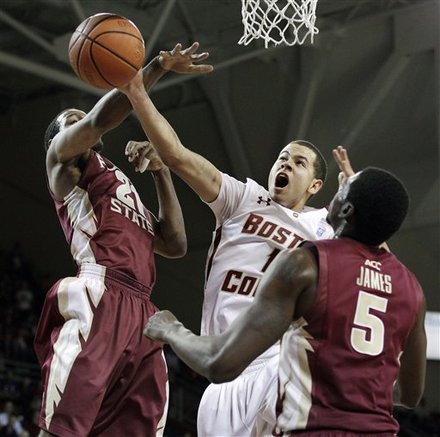
Boston College 64, #17 Florida State 60

It's been a rough year for the few BC basketball fans that bother to show up to the Conte Forum each game. The Eagles were 7-16 coming into last night's game, at the bottom of the ACC standings. But those who did show up were treated with an upset win over Florida State, who were sharing the top of the standings with North Carolina.

To say this has been a rebuilding year might be overly polite to the Eagles. BC is loaded with freshmen, and this season is essentially a lengthy pre-season for the 2012-13 campaign. You can tell that coach Steve Donahue is trying to teach his team how to play the game properly, so once their skills are honed, they can contend to return to the NCAA tournament.

Which means this season's games look more like practices and scrimmages. Except when BC hits 10 of its 22 three-pointers and Florida State turns the ball over 14 times.

I think the Eagles will be respectable in a few years. This wasn't a glimpse of things to come as much as it was a statistical aberration. But it was quite fun to be there and watch it. And the 4,000 or so who showed up got more than their money's worth, and got their loyalty rewarded.

Photo Credit:
AP Photo

Wednesday, October 26, 2011

Feasting on the Big East

It looks like West Virginia is headed to the Big XII. This will be the third defection of a Big East school to another conference this season, and the sixth this decade. That's not counting TCU's decision to move to the Big XII. With WVU, Syracuse, and Pittsburgh leaving, what will happen to the Big East as a football conference? Can it maintain its BCS standing, or will it become a "mid-major?" Or worse?

Louisville, Rutgers, South Florida, UConn, Cincinnati. Five teams. That's all the Big East has for football. That won't work in the BCS. The Big XII is the next smallest BCS conference with at least 10 teams (11 if Missouri stays). Meanwhile, the ACC will have 14, the SEC 13, and the Pac-12 and BigTen have 12 each. So the Big East must add at least 3 teams (preferably more) to remain in the BCS.

But who will they be? In '05, they added Louisville, Cincinnati, and USF to their football league. Back then, there were plenty of solid C-USA programs to invite. Then UConn promoted its football team to I-A. These newcomers claimed 4 of the last 5 conference titles.

But who is out there for the Big East now? That well has gotten very dry. Houston is 7-0 this year, but was 5-7 last year. The Big East wants to add them. UCF was 11-3 last year, they're 4-3 this year. They are a Big East target. SMU is 5-2, but they've barely reached bowl eligibility in recent years and were 1-11 in 2008. The Big East is interested. These are the teams that could replace WVU, Syracuse, and Pitt. That's hardly worthy of a BCS berth.

Oh, the Big East has also been prodding Villanova to bring its football program up to I-A. The Wildcats are 1-7 this year (they beat Penn) down in I-AA.


There have been rumors that the Big East wants to add Air Force, Navy, and even Boise State as football-only members. Obviously Boise State would dramatically improve the conference. But why would the Broncos do it? They've reached the BCS without an automatic bid. They'd have to figure out what conferences their other sports would play in. And do they want to play their road games in Connecticut, New Jersey, and Ohio?

And who buys a ticket to climb aboard a sinking ship?

This ESPN.com article describes a convoluted plan to merge the Big East, C-USA, and Mountain West together as one super-league, with around 30 teams in 4 divisions, a playoff, and hopefully the winner receiving an automatic BCS berth. I think it's a bit too harebrained to even attempt.

The Big East isn't out of danger, either. Louisville is a rumored target of the Big XII. UConn and Rutgers would accept invitations to the ACC in a heartbeat. And if that happens, the Big East is essentially dead. It'd be USF and Cincinnati. Maybe Houston, Navy, UCF, and SMU would join them. But they would certainly not be a BCS conference anymore. They'd fall somewhere between the Mountain West and C-USA.

It's kind of sad. But the Big East has always been a bit too weird. Intentionally so. It was founded as a basketball conference, with the football side forming more than a decade after its original founding. The other conferences were about regional and historical teams joining together to compete in multiple sports. The Big East was about TV revenue from the start. They just picked the wrong sport to focus on.

They snubbed Penn State in 1985, and they've been different from every other conference since then. The idea of 8 football programs and 16 basketball programs sounds nice and neat, but it's messy. The Big East has always been two conferences with one label. How can you let Notre Dame benefit from basketball revenue when they don't share football revenue? How must schools like Georgetown and St. John's feel now that their basketball league is being threatened due to football? It's a crazy mess and always has been. Conferences are supposed to organize and regulate chaos, not cause it.

And a football conference centered in the northeast was doomed to fail anyway. You do have BC, Syracuse, Pitt, and WVU up here. Also up-and-coming programs like Rutgers and UConn. But we've seen that these teams are not going to decline the opportunity to be a part of big time college football, which is based in the South and the Midwest. That's where the big games are, that's where the money is.

Big East football is on life support. And the basketball is severely crippled. 19 Big East football titles have been awarded. And 15 of those are in the trophy cases of schools that have joined or will soon join other conferences. If UConn, Louisville, and Rutgers depart, say goodbye to 2 more football titles, not to mention UConn's basketball programs, along with the 20,000+ fans that Louisville averages at their basketball games. Don't forget about completely losing the New York market once Syracuse, UConn and Rutgers are all playing in the ACC.

As unfortunate as watching the slow death of a conference can be, the moves by West Virginia and TCU almost guarantee that the Big XII will survive. One conference dies, another lives on. The Big East has become an unwilling organ donor, sacrificing its parts to make other conferences healthy again.


The Big XII was in jeopardy a few months ago, but now look very strong. And they can add teams if they want to, like Louisville. They could add Houston to bolster their numbers (as opposed to the Big East, who would add Houston to compete for conference titles). The Big XII can offer Boise State a BCS bid along with geographic convenience. Same with BYU. And the Big XII's monopoly on Texas high school recruiting is an enticement no other conference can match.

The Big East will not be a BCS conference. It will be fortunate to remain in existence as a football league. The Big XII is safe, and might even grow to 12 members once again. Maybe more.

Wednesday, September 21, 2011

College Football Musical Chairs


The musical chairs of college football continue as Pitt and Syracuse will be joining the ACC. The move not only improves the football of the conference, it also dramatically improves the quality of the basketball. Syracuse, Duke, and UNC will all be directly competing against each other. The move also widens the ACC's footprint in the Northeast.

The ACC could stay at 14 teams, or it could easily expand to 16. UConn and Rutgers are very willing to join. Notre Dame has been rumored to be a target, and would obviously bring huge amounts of revenue and exposure to the conference. As a BC fan, I'd love if UConn and Notre Dame were to join Boston College in the ACC.

But Notre Dame's ample revenue streams are precisely why they won't join the ACC. They don't want to split their football money with anyone.

The ACC adding teams makes sense for several reasons. Obviously, adding quality football and basketball programs increases shared revenue for everyone. Also, the SEC is lurking, like a shark in deep waters and the ACC needs to protect itself.

Nobody knows how hungry the SEC will be to add teams. But if they do have an appetite, ACC programs like Miami, Florida State, and Virginia Tech might be on the menu. The ACC is actively defending itself in case that happens.

The Pac-12 has announced that it won't expand... today at least. They're happy with a 12 team conference and they'll all be making plenty of money.

This means that most of the Big XII is safe... today at least. Texas A&M will shuffle over to the SEC, and will likely do so uncontested now that the Big XII as a conference can still survive with 9 members. They may also add BYU or even West Virginia. The SEC has denied that it has already added Missouri.

The Big East is on life support. This isn't the first time. When BC, Miami, and Virginia Tech left, many thought that the Big East would die. So I don't want to start writing its obituary, but things seem worse this time around.

The Big East will be down to 7 teams with the departure of Pitt and Cuse (and the addition of TCU). If UConn and Rutgers defect to the ACC and West Virginia to the Big XII, the conference will either have to disband, or add low quality teams to survive. There simply aren't that many good non-BCS programs out there to add, though. Boise State, obviously. But who else? Houston? Central Florida?

I think the ACC will become the first 16 team "super-conference." They'll be an experiment for the other conferences to watch. If it works, then the SEC and others will follow.

We might end up with 4 BCS conferences (ACC, SEC, Big Ten, Pac-16), each with 16 teams, 4 divisions, and 2 rounds of playoffs. Then maybe the 4 conference champs, plus 2 wild cards could be in a National Championship playoff. That'd be fine with me.

Tuesday, August 23, 2011

Why Miami Should Get the Death Penalty

The NCAA should kill Miami's football program, for at least a year. Miami should not be allowed to field a football team until its program has righted itself. More importantly, the Hurricanes need to be an example. If schools and programs don't check their players and coaches, the NCAA should let it be known that the consequences will be dire.

What might stop the NCAA from imposing the Death Penalty is exactly why the NCAA should impose it. The Death Penalty would punish the enitre ACC, it would punish the 12 teams Miami is scheduled to play in 2011. It punishes the 5 teams that Miami was going to visit this year. It punishes other sports teams at the school, and the university as a whole. It even punishes the economy of southern Florida. Everyone suffers, from the rich owner of hotels near Sun Life Stadium to the cleaning crew picking up trash after the game.

All these people are not responsible for what Miami's football program has done. But from now on, they'll be watching that program. And so will the interest groups surrounding other big football programs across the country.

Currently, the NCAA tries to monitor and discipline all the schools and programs in the country. That's a tough task. That's over 10,000 D-IA scholarship football players to keep tabs on, plus over 4,000 scholarship basketball players in D-I. And that's just the big money making programs. With so many athletes at so many schools, there has to be a more effective system of supervision and discipline.

It's all about pressure. If Miami receives the Death Penalty, there'll be pressure on the football team to clean up. That pressure will come from the school's trustees, from the AD, from local politicians. And there'll be pressure to keep the program clean once it's resurrected.

Going forward, the NCAA needs to apply pressure to the conferences. When USC was banned from postseason play for 2 years, the then Pac-10 suffered by losing potential bowl revenue. However, the Pac-10 did not have to relinquish the ill-gotten bowl money that USC was paid for their 2005 Rose Bowl appearance. It might seem unfair to punish the whole conference for USC's transgressions, but isn't it also unfair to reward the whole conference for USC's transgressions?

If the NCAA fines conferences for what happens with individual programs, the conferences will suddenly become excellent watchdogs. The schools running clean programs will lean on those running dirty ones to straighten themselves out. The conferences will investigate their programs. And instead of the NCAA monitoring 120 football teams, each conference can focus on the 8 or 10 or 12 programs under their supervision. That's just so much more efficient.

No conference has been directly punished for the violations of a program under their authority. Not surprisingly, I can't recall a single time that a conference reported a violation to the NCAA. The conferences aren't being watchdogs, because there's no pressure on them to do so.

If the NCAA holds conferences more accountable for what goes on underneath their noses, the NCAA also needs to grant the conferences more power. Conferences should be allowed to withhold TV and bowl game revenues from teams that are violating the rules. And once Athletic Directors are threatened with that possibility, they're going to be watching their coaches like a hawk.

Once the ADs scare the coaches, the coaches will realize that their job depends on the players they coach obeying the rules. The coaches will no longer wait until there's an accusation of foul play until they get off their asses and investigate. They'll actively take an interest in the financial lives of the players under their charge. And when a defensive end suddenly has a new Lexus, they'll take notice.

If the NCAA applies pressure to the conferences, the conferences will apply pressure to their schools. The schools will apply pressure to their programs. The programs will then apply pressure on the coaches, who will apply pressure on the players.

A few weeks ago, Ohio State's football program went unpunished for the memorabilia violations of its players, and the failure of the head coach to report it. The NCAA claimed that the school didn't have knowledge of what was going on, and therefore should not be punished. That's bullshit. In my opinion, Ohio State's football program failed to sufficiently monitor its athletes. Isn't it the job of the program to ensure compliance with NCAA regulations?

As long as the NCAA continues to use passive and soft disciplinary inactions like that, there will be widespread violations of NCAA rules. OSU football was excused for not knowing what was going on in their own program. I believe that OSU, and every other program in the country, needs to be held responsible for what goes on under their supervision. That's the only way to make them actively monitor their athletes' behavior.

There's always going to be sketchy boosters and agents giving money, cars, and girls to athletes. But if the NCAA overhauls its disciplinary system, and holds conferences responsible for their schools, schools accountable for their programs, programs responsible for their athletes. then epidemics of corruption like that at Miami won't occur. There will be single, isolated incidents. But there won't be systems of negligence and abuse that go on for years and involve dozens of athletes and coaches.

It's all about applying pressure, and making people scared that they might lose some money.

Why College Athletes Shouldn't Get Paid


In the maelstrom of the Miami scandal, I've been hearing many people suggest that it's time for the NCAA to allow schools to pay their athletes. After all, athletes in some sports generate huge amounts of revenue. And while they receive a free education, they're hardly living the high life on their weekly food stipends. It all seems so unfair.

And after what's been happening at Miami and other schools, it seems like a system of paying college athletes would be better than random boosters hooking them up with prostitutes and cars. Athletic salaries would put cash in the players' pockets, which would make them less likely to seek and/or accept illegal "gifts" from outside their institution.

There's a few problems, though. While big football and basketball programs do create revenue streams, that money isn't going to an owner or to a corporation. It's going to a school. And that school takes that money and reinvests it within itself. The money produced by a big football program can help pay a tennis programs' travelling expenses, it can refurbish a soccer field, pay for a new Zamboni. Or outside of athletics, it can pay for the renovation of science labs, for campus security, for more teachers, for better computers.

While it might seem fair to compensate the athletes that play for revenue producing teams, it's impossible to pay them and not deprive funding for another athletic program or part of the school.

I believe that athletics are an important part of education. Do you know what Division-I school fields the most intercollegiate varsity teams? Harvard. They field teams in 41 sports, so they must feel as though sports are important, and surely not just for the revenue. I doubt that the Ivy League's TV contract is particularly lucrative.

The lessons learned by playing sports can be invaluable in the real world. That's why I have no problem with state and Federal money helping to fund athletics (most big-time athletic programs are at state schools, and even the one's in private schools receive Federal assistance). That's also why I believe in Title IX. Because if schools are going to argue that athletics is an important part of education, then athletics cannot be just for the boys to benefit from.

If athletics are important to the educational experience, then sports and teams that generate revenue shouldn't receive special treatment, especially at the expense of the teams that don't generate revenue. It might seem unfair to not pay a Heisman winning QB that wins a national title, but it's unfair if that QB received a $50,000 paycheck and subsequently the baseball team couldn't afford bats and helmets so the team had to fold.

There are unfortunate stories of athletes hamstrung by NCAA rules, and forced to drop out because even with a full scholarship, they're restricted from earning enough money on their own to support a parent or a child. Perhaps the NCAA can make special exceptions in such cases, and allow an athlete to get a job and earn money. But just because there are a few of these sad stories, doesn't mean that the whole SEC should receive a paycheck. There are countless regular people who cannot finish or even start their college education because of financial constrictions. Why should someone be an exception just because they know how to read a blitz?

I struggle to sympathize with the plight of a college athlete. While some generate revenue, there is no greedy, mustachioed owner exploiting them, pocketing all that revenue for his own evil schemes. All schools are non-profit organizations. These athletes receive a free education, which can be worth upwards of $100,000. That means that when they graduate, they'll have no student loans to pay off. And there's no shortage of companies run by alumni who will give a middle linebacker a job in middle management.

I've heard it suggested that the NCAA should allow boosters to pay athletes. After all, isn't that sort of like tipping a bartender for doing a good job? And that would allow the school to continue to reinvest the money it makes off of its big teams. But this creates a massive conflict of interests. In the Miami scandal, some boosters offered bonuses for big hits against Miami's rivals. That impacts a game. What if a booster offers a reward for sacking the QB? That might encourage a defensive lineman to rush upfield Dwight Freeney style, instead of listening to his coach and defending the run. That impacts the game.

If boosters pay athletes, those athletes are beholden to them. In other words, the boosters become the bosses. The coach loses power, the school loses power, the boosters can even discipline players by cutting salary. Most disturbing of all is the idea of boosters having an impact on how the game is played. And how long would it be before a gambler started paying players to do things?

Compensating athletes would likely suppress the amount of illegal payments that are made by boosters. What else could suppress such payments is a comprehensive overhaul of the disciplinary hierarchy of college sports. The schools and conferences need to step up and take charge over monitoring their athletes. The NCAA cannot possibly keep tabs on 120 football programs, each with 85 scholarship athletes (that's over 10,000 players). I'll discuss the measures the NCAA, conferences, and schools need to take in my next post: Why Miami Should Receive the Death Penalty.

Tuesday, March 08, 2011

BOSTON COULD SEND 3 TEAMS TO TOURNAMENT


It's the one month of the year that I actually follow basketball and can't get enough of it. And the city of Boston might send three representatives to the big tournament. BU, Harvard, and BC all have very good chances of earning bids.

BU will host Stony Brook Saturday afternoon at Agganis Arena to determine the America East Championship. The Terriers beat Stony Brook twice this season, boast a 12-4 conference record, have won 10 straight, and haven't lost at home since December. BU haven't made the NCAA tournament since 2002.

Harvard (yes they play in Boston, their court is in Brighton) is in one of the more interesting situations in college basketball. The Ivy League doesn't hold a tournament, and sends its regular season champ to the NCAAs. The Crimson beat 1st place Princeton 79-67 over the weekend. Princeton plays Penn tonight. If Princeton loses, then Harvard wins the Ivy League outright. If Princeton wins, then they and Harvard will meet in a playoff game at a neutral site (Yale). That game would be played on Saturday. Harvard hasn't been in the NCAA tournament since 1946. That tournament featured a field of 8 teams, including NYU and Oklahoma A&M.

By the way, Harvard beat both BU and BC this season.

BC have been popping in and out of the at-large bubble all season. They finished 5th in a lackluster ACC, don't have an overly impressive resume, and if a few upsets occur in the mid-major tournaments, BC might have to do work in the ACC Tournament.

The good news is that BC faces Wake Forest in the opening round of the ACC tourney. They trounced Wake a few days ago, 84-68. But they need to win this game. With losses against Harvard, Yale and URI already marring their schedule, they can't afford to add 8-23 Wake Forest to that list.

After Wake, the Eagles would face Clemson, who they lost to in February. Although it's easier to beat Clemson than it is to beat UNC or Duke. With both teams on the bubble, BC vs. Clemson might essentially be a play-in game into the NCAA tournament. BC last appeared in the NCAAs in 2009.

So come Selection Sunday, there may be three Boston representatives in the 68 team field. Or none.

PS: Can we retire the phrase "punch their ticket?" It's just so antiquated, overused, and stupid.

Wednesday, March 10, 2010

WHY MESS WITH A PERFECT THING? PLEASE DON'T EXPAND THE NCAA TOURNAMENT


Would you want a plastic surgeon's knife mutilating Angelina Jolie's lips, Scarlett Johansson's chest, or Natalie Portman's eyes? Would you want Tom Brady to change his throwing mechanics, maybe go back in time and tell Ted Williams to try hitting right-handed?

The NCAA Tournament is as close to perfection as any sports contest can be. It's 65 teams, playing all over the country, non-stop, for a few weekends in March. EVERYONE in the country obediently watches. It's thrilling, compelling. You cannot NOT watch it.

Yet, the NCAA wants to ruin its own perfect baby. Why is it that they want to expand the field of the already massive basketball tournament (65 of the 347 teams in Division-I or 18.7% of all teams make the tournament), yet keep the college football championship field to 2 teams (2 of 120, or 1.7%)?

Adding 3 more play-in games wouldn't be a bad idea. The 16th seed teams are really awful, and this could raise the average quality of the field. But let's keep the changes small and gradual. Baby steps.


Who complains about the NCAA tourney? Who is out there screaming "We need more teams!" "96 or bust!" Why is it that millions bitch about the BCS and nothing happens. Then nobody says a bad thing about the basketball tournament, and the NCAA wants to tinker and toy with it.

And isn't the money enough for the NCAA and all the conferences? CBS pays $545 million to broadcast these games. Every year. Is that not enough this day and age?


And who's going to watch these extra games? An expanded field of 96 would dump most of the small conference champions together, eliminating half of them before the REAL tournament started. It would essentially create a boring, pre-tournament, that nobody really watched. Nobody wants to see IUPUI play Weber State. They want to see IUPUI challenge Georgetown. David vs. Goliath was interesting because Goliath was there.

I love the NCAA tournament. 80% of the college basketball that I watch in a season is in March.

Don't fuck with it.